
Categories
Tags
Recent Blogs
Concrete Pump Wear Parts: Wear Plates, Cutting Rings, Pistons and Pipes

What are concrete pump wear parts?
Concrete pump wear parts are the components that touch moving concrete and wear with every pour: the wear plate and cutting ring, the S-tube (also called the S-valve, swing tube or S-pipe), the concrete pistons and delivery cylinders, and the delivery pipes, elbows, clamps and end hose. They are replaced regularly to keep pressure, output and safety.
| Component | Job | Wear sign | What to send |
|---|---|---|---|
| Wear plate | Seals the face between the delivery cylinders and the S-tube | Grooves, washed-out edges, concrete leaking past | Pump make, model, cylinder diameter |
| Cutting ring | Seals against the wear plate as the S-tube swings | Uneven wear, chipped hard face, growing gap | Pump make, model, S-tube type |
| Concrete pistons | Push concrete out of the delivery cylinders | Cement paste in the water box, dropping output | Pump make, model, cylinder diameter |
| Delivery cylinders | Hold the concrete pushed by the pistons | Scoring, worn chrome, fast piston wear | Pump make, model, cylinder diameter and length |
| Delivery pipes | Carry concrete along the boom or line | Thin walls, bulges, leaks at joints | Pipe size, length, coupling type |
| Elbows and bends | Change direction of the line | Wear on the outer curve, thin spots | Pipe size, bend angle, coupling type |
Before you ask for a quote, have this short checklist ready:
- Pump make and model, from the pump nameplate
- Cylinder diameter, for pistons, cylinders and the wear plate
- Pipe size and coupling type, for pipes, elbows and clamps
How fast these parts wear depends on the job. Abrasive aggregates, harsh or high-cement mixes, long pumping distances and hot weather, such as summer pours on Gulf sites, when concrete stiffens faster, all increase wear and the risk of blockages. Thorough cleaning after every pour also matters, because set concrete left in the S-tube or pipes damages parts on the next start.
How do wear plates and cutting rings wear, and how do you check them?
Wear plates and cutting rings wear as abrasive concrete is forced between them each time the S-tube swings. Check them after cleaning at the end of each pumping day: look for grooves, washed-out edges and an uneven or growing gap. Concrete or water leaking past the seal shows the pair is worn.
- Look at the faces: both should wear evenly. Deep grooves or a washed-out channel on one side mean the seal is failing.
- Check the gap: on many pumps the gap between the wear plate and cutting ring can be closed by adjustment as they wear, following the pump maker's procedure. When the gap can no longer be closed, the parts need replacing.
- Check the hard facing: chipped or missing hard-metal segments speed up wear on the matching part.
- Watch the pump: loss of pressure, a pulsing line or concrete bleeding back into the hopper point to a worn seal.
The S-tube itself also wears, especially at the outlet end and along the inside of the bend. Check its wall and the outlet face whenever the cutting ring is changed, so a new ring is not fitted to a worn tube.
A worn pair wastes concrete, puts more load on the hydraulics and can cause blockages. Catching wear early keeps the boom pump working through the pour.
When do concrete pistons need replacing?
Concrete pistons need replacing when cement paste or grit appears in the water box, when the piston rubber is torn or worn, or when output drops at normal pump settings. The water box behind the pistons is the easiest place to spot wear, so check the water at every pumping day.
- Cloudy or gritty water in the water box means paste is getting past the pistons.
- Lower output at the same settings can mean the pistons are not sealing.
- Torn, cracked or swollen piston rubber seen during an inspection.
- Scored delivery cylinders: if the cylinder wall is worn, new pistons will wear quickly. Check the cylinders whenever pistons are changed.
Change both pistons at the same time, so they wear evenly and the pump stays balanced on each stroke.
Keep the water box full of clean water while pumping. It cools and lubricates the pistons, and dirty water is the first warning that they need attention.
How do delivery pipes and elbows wear?
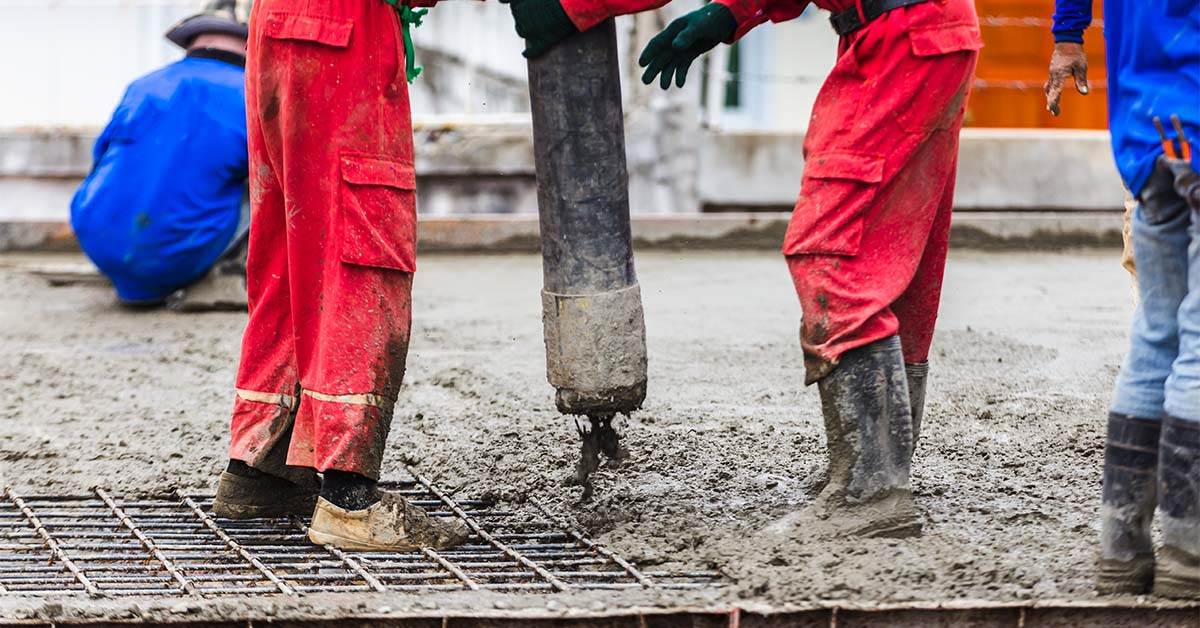
Delivery pipes and elbows wear from the inside as concrete flows through them. Straight pipes wear most along the bottom, and elbows wear fastest on the outer curve. Measure wall thickness with an ultrasonic gauge at regular checks, because a worn pipe can burst under pumping pressure.
- Measure, do not guess: an ultrasonic thickness gauge reads wall thickness from the outside without cutting the pipe.
- Rotate straight pipes: turning a pipe on its axis spreads wear more evenly around the wall.
- Check elbows first: bends and the reducer near the pump usually wear before straight sections.
- Inspect clamps and gaskets: worn couplings leak paste and can open under pressure.
- Follow the pump maker's limits: replace pipes and elbows at the minimum wall thickness the pump maker gives.
Pipe wear is a safety issue for the crew on site, so a pipe that is close to its limit should be taken out of the line, not kept for one more job.
The end hose moves more than any other part of the line. Check it for cuts, kinks and a worn outlet, and replace it if the cover is damaged, because a burst end hose is a direct hazard to the person guiding it.
What should you send to get a quote for concrete pump wear parts?
Send the pump make and model from the nameplate, the cylinder diameter, and the pipe size and coupling type, with a photo of the worn part. List each part and quantity you need. With these details, the right wear parts can be matched to your pump before you order.
- Browse concrete pump parts, including wear plates and cutting rings, and truck mixer parts.
- Register a business account to order online and request quotes.
- Send a full wear parts list for your pumps through the bulk enquiry form.
If you are not sure of the cylinder diameter or pipe size, a photo of the pump nameplate and of the worn part, with a tape measure across it, is usually enough to start the match.
Readymix and concrete pumping companies running several pumps can combine wear parts for the whole fleet into one list, grouped by pump make and model.
Gulf Parts Center supplies automotive, heavy equipment and industrial spare parts to businesses across the GCC, with next-day delivery to Saudi Arabia, UAE, Kuwait, Oman and Qatar, including customs clearance.
Frequently asked questions
What is the difference between a wear plate and a cutting ring?
The wear plate is the fixed plate in front of the delivery cylinders. The cutting ring is fitted to the moving S-tube and seals against the wear plate as it swings. Together they form the seal that stops concrete leaking between the cylinders and the S-tube.
Should a wear plate and cutting ring be replaced together?
Check the pump maker's guidance. The two parts wear against each other, so many crews inspect and replace them as a pair, but some pumps allow one part to be replaced if the other is still within limits.
Which pump details are needed to order wear parts?
The pump make and model from the nameplate, the delivery cylinder diameter, and the pipe size and coupling type for pipes and elbows. A photo of the worn part helps confirm the match.


