Categories
Tags
Recent Blogs
Hydraulic Gear Pump vs Piston Pump: Choosing the Right Replacement

What is the difference between a hydraulic gear pump and a piston pump?
A hydraulic gear pump moves oil with two meshing gears and always delivers a fixed volume per turn. A hydraulic piston pump moves oil with pistons in a rotating block, and many designs can vary their output. Piston pumps handle higher pressures with better efficiency; gear pumps are simpler, smaller and cost less.
| Gear pump | Piston pump | |
|---|---|---|
| Design | Two meshing gears (external) or a gear inside a ring (internal) | Pistons in a rotating cylinder block, axial or radial |
| Displacement | Fixed | Fixed or variable, depending on the design |
| Relative pressure | Low to medium | Medium to high |
| Efficiency | Good when new; falls as gears and housing wear | High, and holds up better under load |
| Tolerance to dirty oil | Higher; less sensitive to contamination | Lower; needs clean oil and good filtration |
| Typical machines | Forklifts, tipper and crane PTO drives, auxiliary and pilot circuits | Excavators, concrete pump main circuits, truck mixer drum drives |
Before ordering, read the pump nameplate; the details to take are listed under "What information do you need to match a replacement hydraulic pump?" below.
Cost follows design. A piston pump has more precision parts and, on variable designs, a control unit, so it costs more to buy and to repair. A gear pump has few moving parts and is easy to replace, which is why it stays common on forklifts, PTO drives and smaller circuits.
Which machines use gear pumps and which use piston pumps?
Gear pumps are used where a simple, steady flow is enough: forklift lift and steering circuits, truck PTO drives for tippers and cranes, and pilot or auxiliary circuits. Piston pumps are used where high pressure or variable flow is needed: excavator main circuits, concrete pump main circuits and truck mixer drum drives.
| Machine | Main pump type | Where gear pumps also appear |
|---|---|---|
| Forklift | Gear pump | Lift, tilt and power steering circuits |
| Truck mixer | Variable piston pump driving a piston motor on the drum | Water pump or auxiliary circuits on some models |
| Concrete pump | Piston pumps for the pumping circuit | Agitator, boom or cooling circuits on some models |
| Excavator | Variable piston pumps for the main circuit | Pilot circuit pump |
| Tipper or crane truck | Gear or piston pump on the PTO, by system design | Tipping and crane circuits |
Many machines use both types: a piston pump for the main work and a gear pump for pilot pressure or a smaller circuit. When a pump fails, identify which pump it is before ordering.
Truck mixer drum drives usually work as a closed circuit, where the pump and the drum motor run as a matched pair. When one of them fails, check the other and clean the whole circuit, because debris from a failed unit can damage the new one.
Can you replace a piston pump with a gear pump?
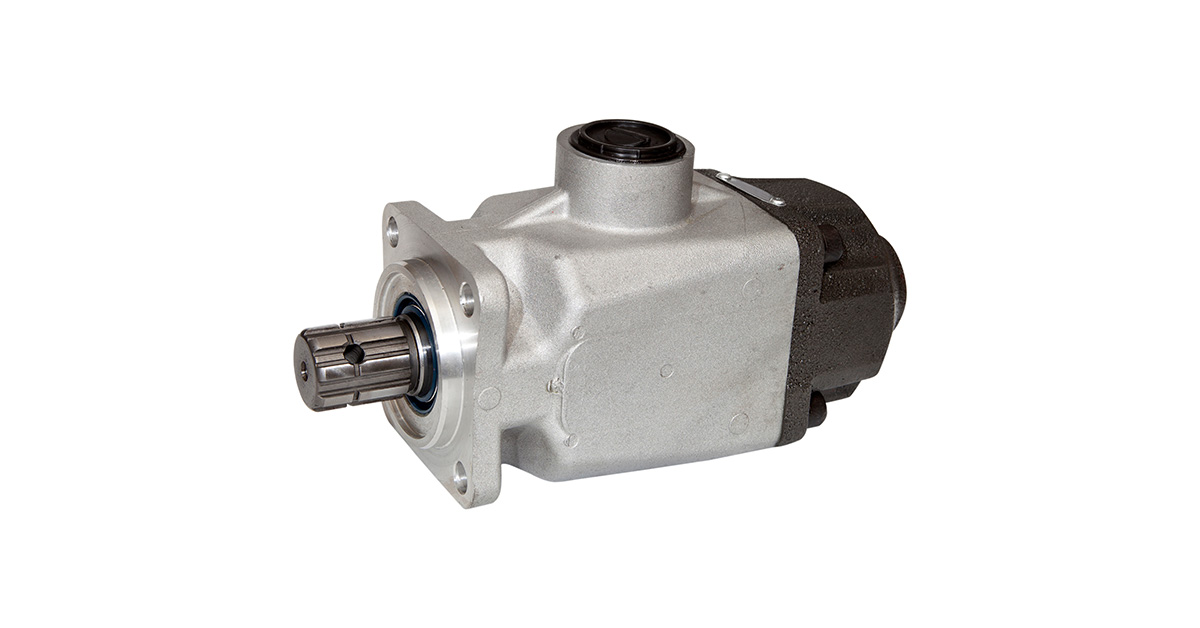
In most cases, no. A piston pump is chosen for its pressure range, efficiency and, often, variable displacement controlled by the machine's hydraulic system. A gear pump cannot do the same job, so the safe rule is like-for-like: replace a pump with the same type, displacement, rotation, shaft and mounting.
- Variable to fixed does not work: load-sensing and pressure-compensated systems need a pump that can change its output.
- Pressure: check the nameplate and the machine's hydraulic data; a gear pump may not be rated for the circuit.
- Heat: a less efficient pump turns more power into heat, and high summer temperatures make this worse.
- Changes need an engineer: any change of pump type should be approved by the machine maker or a qualified hydraulic engineer.
The opposite change, fitting a piston pump in place of a gear pump, is also rarely needed and can mean new controls, hoses and mounting. A like-for-like replacement is quicker and keeps the machine working as designed.
What information do you need to match a replacement hydraulic pump?
To match a replacement, you need the pump's make and model code, displacement, rotation, shaft type and size, and mounting flange, all read from the nameplate. Add the machine make, model and serial number, and photos of the pump, shaft and ports. With these details, a like-for-like pump can be matched before ordering.
| Detail | Where to find it | Why it matters |
|---|---|---|
| Make and model code | Pump nameplate | Identifies the exact pump |
| Displacement | Nameplate or model code | Sets the flow at a given speed |
| Rotation | Nameplate or arrow on the housing | A pump turning the wrong way will not work |
| Shaft type and size | Measure the shaft or check the model code | Must match the drive coupling |
| Mounting flange and ports | Count the bolts and measure the pilot; note port positions | Must fit the drive and existing hoses |
| Machine make, model and serial number | Machine data plate | Confirms the pump fitted at the factory |
Before ordering, confirm the pump is really the problem. Noise, slow functions and hot oil can also come from a blocked suction filter, an air leak on the suction side, low oil or a faulty relief valve. Checking these first can save the cost of a pump the machine did not need.
If the nameplate is missing or unreadable, photos of the pump from several sides, with the shaft and ports visible, and a note of the machine details are the next most useful thing to send. Do not check pressure by guesswork; check the nameplate or the machine's hydraulic data.
How do you order a hydraulic pump from Gulf Parts Center?
Send Gulf Parts Center the nameplate details and photos of the pump, with the machine make, model and serial number. Gulf Parts Center uses these details to look for a matching pump and replies with the options available. Gulf Parts Center supplies hydraulic pumps and motors under its own GPC brand and is an authorised OEM supplier for Hydro Leduc.
- Browse gear pumps and piston pumps.
- Register a business account to order online and request quotes.
- Send your pump details and photos through the bulk enquiry form.
When the new pump is fitted, follow the pump maker's start-up instructions. These usually include cleaning or replacing the filters, filling the pump case with clean oil where required, checking the rotation and bleeding air from the system. Contaminated oil left in the system is a common cause of early failure in a new pump.
For fleets, list every hydraulic pump by machine and keep the nameplate details on file. When a pump fails, the replacement can be matched in one step.
Gulf Parts Center supplies automotive, heavy equipment and industrial spare parts to businesses across the GCC, with next-day delivery to Saudi Arabia, UAE, Kuwait, Oman and Qatar, including customs clearance.
Frequently asked questions
Why does a new hydraulic pump fail early?
The most common cause is contaminated oil left in the system, often debris from the pump that failed. Before start-up, clean or replace the filters, clean the circuit where needed, fill the pump case with clean oil where required, check the rotation and bleed air from the system, following the pump maker's instructions.
What is on a hydraulic pump nameplate?
Most nameplates show the make and model code, and the model code or plate usually gives the displacement and rotation. Shaft type and mounting flange are often coded in the model number too, so a clear photo of the plate is the most useful thing to send.
Does Gulf Parts Center supply its own-brand hydraulic pumps?
Yes. Gulf Parts Center supplies hydraulic pumps and motors under its own GPC brand and is an authorised OEM supplier for Hydro Leduc. Send the pump nameplate details and photos through the bulk enquiry form to find a match.


