
Categories
Tags
Recent Blogs
When to Replace Excavator Undercarriage Parts: Rollers, Idlers and Sprockets

How long does an excavator undercarriage last?
How long an excavator undercarriage lasts depends on the ground, the work and how well it is maintained. Industry sources give a wide range: Equipment India (February 2026) puts undercarriage life at between 2,000 and 7,000 operating hours. Replace parts when measured wear reaches the machine maker's limits, not by hours alone.
| Component | Wear sign | How to measure |
|---|---|---|
| Track rollers (bottom) | Worn or uneven tread, oil leaks, rollers that do not turn | Measure tread diameter with a caliper or wear gauge |
| Carrier rollers (top) | Flat spots, seized rollers, oil leaks | Check that they turn freely; measure tread diameter |
| Front idlers | Worn tread or flange, wobble, oil leaks | Measure tread height against the maker's limit |
| Sprockets | Hooked, pointed or thin teeth | Compare tooth profile with a sprocket gauge |
| Track chain | Loose track, stretched pitch, worn link rails | Measure pitch over several links and track sag |
| Track shoes | Worn or bent grousers, cracks, loose bolts | Measure grouser height |
Ground conditions make the biggest difference. Equipment India notes that work on rocky or abrasive surfaces wears undercarriage faster. Sand, gravel and rock, common on many Gulf sites, all speed up wear, while softer ground is kinder to rollers, idlers and sprockets.
Cleaning also helps. Sand and mud packed around the sprocket, idler and rollers act like grinding paste and add weight to the track. Clearing packed material at the end of the shift is a simple habit that slows wear.
What are the signs that rollers and idlers need replacing?
Rollers and idlers need replacing when their tread is worn to the maker's limit, when they leak oil, or when they stop turning freely. Look for flat spots, uneven wear, wobble, a worn flange on the idler and oil on the roller ends. A seized roller wears quickly and damages the track chain.
- Oil leaks: oil on the roller or idler ends means the seals have failed and the bearing will follow.
- Rollers not turning: a roller that does not turn slides on the chain, wears flat and damages the link rails.
- Flat spots or uneven tread: often a sign of a seized roller or poor track alignment.
- Idler wobble or flange wear: points to worn bearings or a misaligned track.
- Track coming off: a track that keeps coming off after adjustment points to worn chain, idler or sprocket parts.
- Measured wear at the limit: compare tread diameter or height with the machine maker's wear limits.
Operating habits matter too. Long travel at high speed, frequent turning on the spot, working across a slope in one direction and running mostly in reverse all add to wear on rollers, idlers and sprockets. Operator training helps extend undercarriage life.
Walk round the machine with the tracks clean. Mud, sand and concrete hide oil leaks and flat spots, so wash the undercarriage before an inspection.
How do you check sprocket and track wear?
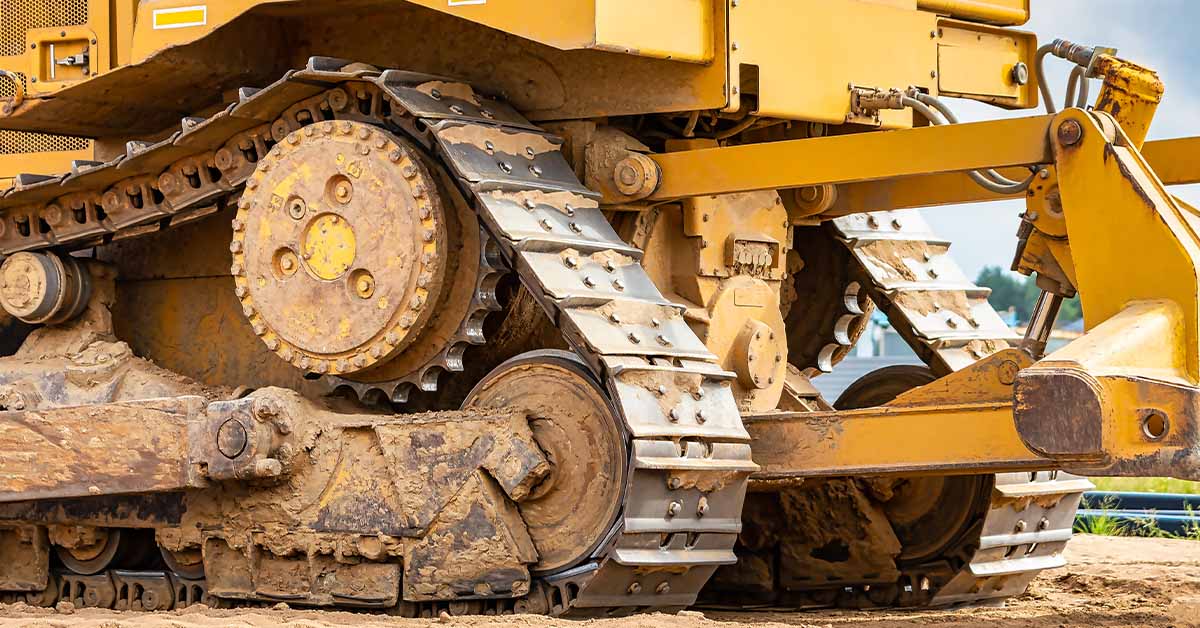
Check sprocket teeth for a hooked, pointed or thinned shape, and compare them with a sprocket gauge. Check the track by measuring sag between the carrier roller and the idler, and pitch over several links, which shows pin and bushing wear. Compare both readings with the machine maker's limits before deciding what to replace.
- Sprocket teeth: new teeth have a rounded profile; worn teeth look hooked or pointed and can make the chain jump.
- Track sag: a track that sags more than the maker allows needs adjusting; if it cannot be adjusted further, the chain is worn.
- Track pitch: measure the length over a set number of links and compare it with the maker's figure.
- Link rails: check the top of the links for wear where the rollers run.
- Track shoes: check grouser height and look for cracked shoes and loose bolts.
Record each measurement with the date and machine hours. Comparing readings between inspections shows how fast each part is wearing, which makes it easier to plan when it will reach the limit.
Track tension matters as much as wear. A track that is too tight wears pins, bushings and sprockets faster; one that is too loose can come off and damage idlers. Set tension to the maker's guidance for the ground you are working on.
Should undercarriage parts be replaced together?
Some parts should be replaced together and some can be replaced separately. Sprockets and track chains wear as a pair, so a new chain on worn sprockets, or new sprockets on a worn chain, wears quickly. Rollers and idlers can often be replaced on their own if the other parts are still within limits.
| Part | Replace together or separately? | Why |
|---|---|---|
| Sprockets and track chain | Usually together | Worn teeth and worn bushings speed up wear on each other |
| Track rollers | Separately, if the others are within limits | Replace any seized or leaking roller at once |
| Carrier rollers | Separately | Usually wear more slowly than bottom rollers |
| Front idlers | Separately, checked with the chain | A worn idler can damage a new chain |
| Track shoes | Separately or with the chain | Depends on grouser wear and cracks |
Measuring all the parts at the same inspection gives the clearest picture. It shows which parts can run longer and which should be changed at the same time, so the machine is down once rather than twice.
For plant hire fleets, planning the change between hires keeps machines earning. Measuring wear before a machine goes out on a long hire shows whether parts should be changed first.
What details are needed to order undercarriage parts?
To order undercarriage parts, send the excavator make, model and serial number from the machine plate, the track shoe width, and the parts and quantities you need. Add photos of the worn parts and any numbers cast or stamped on them. These details are needed because undercarriage parts vary between machine versions.
- Note the make, model and serial number of each excavator.
- Measure and record the wear on each component.
- List the parts to replace on each machine, with quantities.
- Combine the lists for the fleet and send them as one bulk enquiry.
Browse track rollers, carrier rollers, front idlers, sprockets and track adjusters, or register a business account to order online and request quotes. Plant hire companies and contractors running several excavators can plan one undercarriage order for the fleet, based on the measured wear on each machine.
Gulf Parts Center supplies automotive, heavy equipment and industrial spare parts to businesses across the GCC, with next-day delivery to Saudi Arabia, UAE, Kuwait, Oman and Qatar, including customs clearance.
Frequently asked questions
What is the average lifespan of an excavator undercarriage?
It depends on the ground and how the machine is used. Equipment India (February 2026) puts undercarriage life at between 2,000 and 7,000 operating hours, with faster wear on rocky or abrasive ground. Measure wear against the machine maker's limits to decide when to replace parts.
How do you tell if an undercarriage is worn?
Look for oil leaks on rollers and idlers, rollers that do not turn, hooked or pointed sprocket teeth, a track that sags beyond the maker's limit, and worn grousers. Then measure the parts and compare them with the maker's wear limits.
Does track tension affect undercarriage wear?
Yes. A track that is too tight wears pins, bushings and sprockets faster, and one that is too loose can come off and damage the idlers. Set tension to the machine maker's guidance for the ground you are working on, and check it when the ground conditions change.


